Room to Swing: How to Pick an Overnight Anchorage You Won’t Regret at 3 a.m.
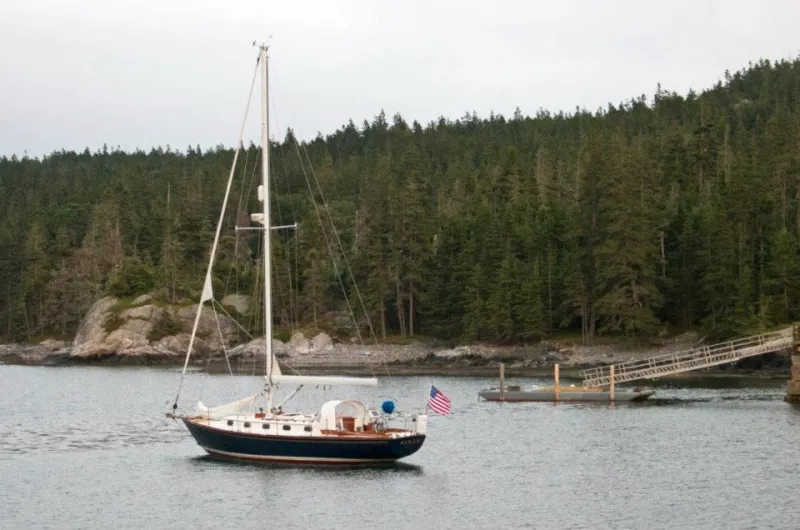
Photo: HopsonRoad, CC BY-SA 4.0, via Wikimedia Commons
There is a particular kind of optimism that comes with dropping the hook in a pretty cove on a still afternoon. The water is glassy, the kettle is on, and the evening looks like a postcard. Then the tide turns, the wind backs twenty degrees, and you spend the next six hours lying awake listening to the chain. Picking an overnight anchorage is not difficult, but it is a skill — and most of it happens before you leave the cockpit.
Start with the wind, not the view
The first question isn’t “where looks nice?” It’s “where will the wind come from while I’m asleep?” A forecast for the evening is only half the story. Look at the overnight trend, the gust range, and the direction it will settle in by dawn. A cove that is perfect in a westerly can become a rolly, uncomfortable lee shore when the wind swings into the east.
Shelter is about fetch as much as direction. A headland that blocks the wind may still leave you open to a mile of swell. On the chart, ask yourself what lies between you and the open sea in the predicted wind. If the answer is “not much”, keep moving. A quiet night usually beats a picturesque one.
The tide will reorganise your plan
Anchoring is a moving calculation. You need to know the depth at high water, the depth at low water, and how much chain you can reasonably lay out. A spot that looks generous at dusk can feel tight at 3 a.m. when every boat in the bay has swung on a different combination of chain and rope.
Work out your swing circle before you commit. Add your chain scope, your boat length, and a sensible margin for the neighbours. In a busy cove, that circle is often bigger than the gap you’ve been eyeing. If the maths is marginal, find somewhere else. There is no prize for squeezing in.
Also check the chart for drying patches, rocks, moorings and exclusion zones. Harbour notices matter, especially where seagrass or protected seabed is involved. A peaceful night is not worth an angry email from the harbour authority — or a anchor dragging through something it shouldn’t.
Holding ground is a conversation with the seabed
Sand and firm mud are usually friendly. Thick weed, soft ooze and rock are not. Your anchor may set beautifully in one and skate across the other. The only reliable test is to set it properly: lay out your scope, take a transit, and apply gentle astern power. Watch a fixed point on shore. If the anchor is dragging, the transit will tell you before the wind does.
Different anchors suit different seabeds, but technique matters as much as hardware. Let the boat settle, avoid dumping the whole chain in a heap, and use a snubber or bridle to take the load off the windlass. If the forecast is lively, allow more scope and more room. If it is crowded, consider whether a different anchorage would be kinder to everyone.
Swing room and other people’s boats
Anchorage etiquette is mostly common sense, but it is worth stating. Don’t anchor on top of someone who was there first. Don’t assume everyone swings the same way. Don’t leave a fender dangling over a neighbour’s foredeck because you misjudged the gap. And if someone is already using a long scope in a small cove, give them the space their chain deserves.
Arriving late is no excuse for arriving close. A slow pass around the bay tells you more than any app. Look at how boats are lying, where the moorings are, and which patch of water is obviously empty for a reason. If it feels tight from the helm, it will feel tighter from the bunk.
Five UK spots that tend to get it right
These are not secret spots, and they are not guarantees. Check the forecast, the chart and local notices every time. But they are the sort of places where the basics — shelter, holding and space — usually line up.
Newtown Creek, Isle of Wight. A quiet, muddy creek with good holding and a sense of having slipped away from the Solent. It can get busy, so arrive early and respect the moored boats. The shelter is good in most settled conditions, but the entrance dries and the creek rewards a careful approach.
Osborne Bay, Isle of Wight. A handy overnight stop on the island’s north coast, with sand and mud holding and reasonable shelter from the prevailing south-westerlies. It is not the place to be in a strong easterly, and the summer evenings can be social. Go for the convenience, stay for the sunset over the Solent.
Wootton Creek, Isle of Wight. Another muddy, sheltered creek that feels more rural than its location suggests. Depths are shallow in places, so pick your spot with the chart open and the echo sounder on. It is a good choice when the Solent is doing its best impression of a washing machine.
Dale Roads, Pembrokeshire. Not a cove in the postcard sense, but a reliable anchorage with good holding and shelter from the south-west. The village is close, the scenery is excellent, and the overnight swell is usually manageable. In a strong northerly, look elsewhere.
Porth Dinllaen, Llŷn Peninsula. A lovely curve of sand with shelter from the south-west and west, and a pub within dinghy range. It is exposed to northerlies and easterlies, so treat it as a fair-weather friend. When it works, it really works.
Gear that earns its space
You don’t need a locker full of anchoring exotica, but a few things make a night afloat calmer. A snubber or bridle takes the snatch out of the chain. An anchor alarm is useful, provided you set the radius sensibly and don’t spend the night staring at it. A decent torch, a charged handheld radio and a dry layer for the 3 a.m. check are worth their weight. And a paper chart or offline plotter backup is still a good habit when the phone battery is fading.
A night afloat is a series of small decisions
Good anchoring is not one dramatic moment. It is a series of small, boring decisions: where to drop, how much scope to lay, how far to stay from the boat next door, whether to move before dark. Get those right and the anchorage becomes what it should be — a quiet place to sleep, with the boat doing gentle circles under the stars. Get them wrong and you’ll be on deck at 3 a.m. wondering why the view suddenly matters so much.