Frost on the Toe Straps: Why Winter Dinghy Racing Deserves Your Sundays
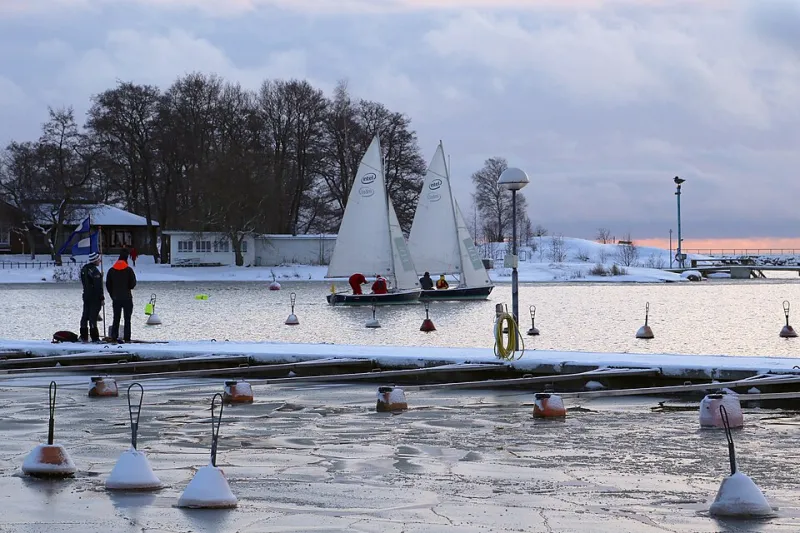
Photo: Jukka from HELSINKI, Finland, CC BY 2.0, via Wikimedia Commons
Every summer, the dinghy park fills with people who have just discovered sailing. Every winter, it empties. That is precisely why you should be there.
The frostbite series is the quiet heart of British club sailing. The name sounds bleak, and on a grey December morning the reality can match it, but the reward is a kind of racing that summer crowds rarely allow: small fleets, sharp starts, hot soup and the unmistakable feeling that you have done something slightly mad and entirely worthwhile.
The season does not end; it just gets quieter
There is a myth that the UK sailing year runs from Easter to October. In reality, plenty of clubs run winter dinghy racing from November through to March. Some call it a frostbite series, some call it a winter series, some just call it Sunday racing and hope the weather behaves. The format varies, but the spirit is the same: turn up, rig, race, thaw out, repeat.
Finding one is not difficult. Start with local club websites and notice boards. Look for phrases like ‘winter series’, ‘frostbite’ and ‘all welcome’. If you are new to a club, ring or email before you turn up. Ask whether there is a handicap fleet, whether you can join as a visitor and what time the briefing is. Clubs are usually delighted to have another boat, especially in January when the start line can look a little lonely.
What to wear when the air bites
Cold-weather dinghy sailing is not about being tough. It is about being properly dressed. A drysuit is the obvious choice for many, but a well-layered wetsuit can work if you are sailing a less demanding boat and staying close to shore. The key is to think in layers: thermal base layer, fleece or mid-layer, then windproof and waterproof outer protection.
Do not neglect the extremities. A warm hat under your helmet, decent gloves and boots that actually keep water out will make more difference than another expensive piece of kit. Take a spare fleece and a towel in the car. Leave a thermos in the boot. A hot drink after racing is not a luxury; it is part of the safety plan.
Safety is not the boring bit
Winter racing has its own risks, and the sensible response is not to pretend otherwise. Cold water shocks the body. A capsize that would be merely annoying in July can become serious in February. Listen to the race briefing, know where the safety boat is and sail within your limits. Check the forecast, rig properly and tell someone ashore where you are going.
A good club will have patrol cover and a clear plan for cold weather. If you are unsure, ask. There is no shame in sitting out a race when the wind and temperature do not add up. The best winter sailors are not the ones who take the most risks; they are the ones who keep coming back because they stayed warm, safe and sensible.
Small fleets, sharp skills
Once the summer crowds have gone, something interesting happens to the racing. The start line is less frantic. There is room to tack, room to think and room to make a proper mess of a mark rounding without an audience of forty other boats. The people who do turn up tend to be keen, which means the standard can be surprisingly high.
That is the secret. Winter racing is not a diluted version of summer sailing. It is a concentrated one. You learn to handle cold hands, short days and shifty breezes. You learn to rig quickly and sail efficiently. You learn that a good start in a fleet of six can feel just as satisfying as a good start in a fleet of sixty.
Soup, tea and the social side
Then there is the clubhouse. Frostbite racing has a social rhythm that summer sailing often loses. People are not dashing off to a barbecue or a beach. They are standing around in damp fleeces, comparing bruises and waiting for the kettle. Soup appears. Someone produces a tin of biscuits. The race officer looks pleased with himself.
This is where the winter series quietly wins. Summer sailing can be spectacular, but it can also be crowded, expensive and oddly hurried. Winter racing is simpler. You sail, you shiver, you eat soup, you go home. The pleasure is in the repetition.
So yes, the toe straps will be cold. The wind will find the gap in your collar. The first beat will feel longer than it should. But the start line will be empty, the air will be clean and the clubhouse will be warm. That is a pretty good way to spend a Sunday.