Five Minutes Before the Pontoon: A Berthing Routine That Keeps the Gelcoat and the Peace
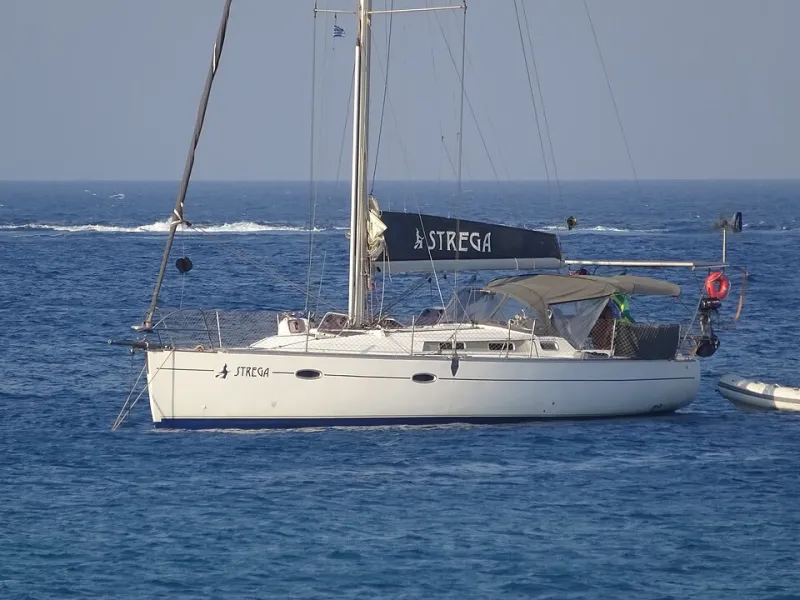
Photo: Pjotr Mahhonin, CC BY-SA 4.0, via Wikimedia Commons
Every marina has one: the arrival that draws a small, silent audience. The engine note rises, a fender skitters down the side deck, somebody shouts a number that isn't a number, and the boat meets the pontoon with a noise that makes three people wince in three different ways. It's rarely the skipper's seamanship that's at fault. It's the fact that nobody agreed, in advance, what the last five minutes were going to look like.
Berthing is a choreography problem dressed up as a boat-handling problem. Sort out the choreography and the handling usually looks after itself.
The order is the whole trick
Fenders go over before lines come out, and lines are made up before you turn into the fairway. That's it. That's most of the article.
But it's worth saying why. Fenders deployed while you're already lined up means somebody is leaning over the rail with their back to the water, still threading a clove hitch, at the exact moment you need them upright and watching. Lines made up at the last second means whoever's on the foredeck is improvising while you're asking them to be an extra pair of eyes. Both jobs are two-minute jobs. The mistake is doing them at the same time as the hard bit.
So: on the approach to the marina entrance, or as soon as you've called them on the VHF and heard the harbourmaster out, everything gets rigged. Both sides, if there's any doubt about which way you'll come alongside — and with a crosswind there always is. Nothing looks more amateur than a boat that has to rethread its fenders mid-manoeuvre with the wind pushing it sideways towards a moored Bavaria.
Height matters too. A fender dropped to the waterline is a fender doing nothing. The rubbing strake, not the waterline, is where a pontoon actually makes contact once the boat settles. Tie off at the height you'll be when you're alongside, not the height you are now.
Give everyone one job and no more
Small-crew berthing goes wrong when people have either too little to do or too much. The fix is one job each, agreed out loud, in plain words, before you get close.
- Skipper: wind, tide, throttle, and nothing else. If you're on the helm you are not also the fender person, and you are certainly not the person explaining the plan for the third time.
- Bow: the headline goes ashore first. This person's entire world is one cleat and one line.
- Stern or midships: the spring or stern line, whichever suits the berth, plus a spare fender in hand if the pontoon turns out to be taller than advertised.
If you're a couple, one of you is bow and one of you is helm, and the boat can wait. A two-person crew can berth almost anything up to about 35 feet in a moderate breeze if both people know their one job. A four-person crew with no roles is worse than a two-person crew with two.
The language matters as much as the assignment. "Take it round the cleat and hold it" is a better instruction than "make it fast", because the second invites a whole knot at the worst possible moment. Boat-to-boat handovers are fine for a moment; boat-to-pontoon with a knot is how people lose fingers and patience.
Read the wind and tide before you commit
A pontoon berth is rarely hard because of the pontoon. It's hard because of whatever is pushing you towards or away from it.
On a rising tide in a river marina, the current runs one way on the way in and gives you a shove on the way out. On a falling tide, you'll find the boat set towards the finger while your prop wash does the opposite. Wind over tide in a narrow fairway gives you that lovely situation where the bow wants one thing and the stern wants another. All of this is readable from the cockpit five minutes out, with a good look at moored boats, a flag on the clubhouse, and the way the tide is running past a mooring buoy.
One practical habit: pick your plan, then pick the conditions under which you'd abandon it. Say both out loud. "We're going in port side to, and if the wind pushes us past the second finger we go round and try again." Giving yourself permission to go around again before you start is the single biggest difference between a calm arrival and a stubborn one.
Slow is steady, and steady is what people watch
There's a strong temptation, in front of an audience, to carry a bit more speed to look decisive. Resist it. A boat with a touch of steerage way and a plan looks far more confident than one arriving briskly and hoping. If in doubt, neutral. If still in doubt, stop, think, and start again.
And do have a word with the audience. A wave towards the pontoon and a cheerful "morning — we're coming in bow-first, don't mind us" does more for your reputation than any amount of skilled throttle work. Half the time they'll take a line. That's not charity, that's a free extra crew member at exactly the right moment.
The bits that go wrong
A short, non-exhaustive list from the school of experience.
Fenders deployed on one side, then the wind decides you're going the other way. Rig both sides when there's any doubt.
Crew on the foredeck the whole manoeuvre, so nobody's watching the quarter where the actual contact will happen. The bow is the glamorous end. The damage is usually at the back.
Lines too long, so they pool on the pontoon and get trodden on, or too short, so they're useless when the boat sits off the berth by half a metre. Make them up roughly, then adjust when you're stationary.
Someone leaping ashore. Unless the person is 20 and wearing proper shoes, no one jumps. Lines go ashore, then people, then everything else.
And the classic: engine in gear while the line handler is standing on the pontoon with a turn round a cleat that isn't quite made off. Keep it in neutral until the line is settled and the handler has said so out loud.
A routine is a kindness
None of this is about perfection. It's about removing decisions from the loudest, most pressured part of the trip so that the person on the helm has a clear head and the person on the foredeck isn't guessing. It's also, bluntly, a kindness to whoever you sail with. Nobody wants to be shouted at at the end of a good day out, and nobody wants to watch their partner climb a ladder with a squashed finger.
Five minutes of rigging, a shouted agreement on roles, and a willingness to go round again. Do that and the harshest thing anyone will say about your arrival is that it was a bit boring — which is the highest compliment a berthing can receive.